
Ramer-Douglas-Peucker polyline simplification
In your harnessMesh algorithmMIT
Simplify 2D or 3D polylines by keeping only points farther than a tolerance from the simplified line, with a measure of the largest deviation. Use it for GPS tracks, contours, strokes and paths.
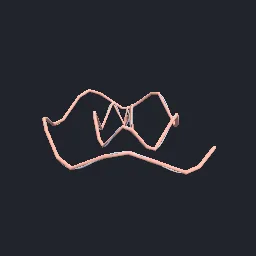
What it takes and gives
- Entry points
- simplify, max_deviation, demo_curve, build, main
- Parameters
- tolerance, samples
- Complexity
- O(n log n) typical, O(n^2) worst case
- Axes
- +Y up, metres
Limits. Distances are measured to chord segments, and the result keeps the original end points. The simplified line can cross itself or other lines (no topology preservation). Not suited to closed rings without choosing a split point first.
Details
- Kind
- Mesh algorithm
- Engine
- Python 3.10 or later
- Files
- 10 files, 300.3 KB
- Licence
- MIT
- Declared effects
- reads files, runs commands, writes files
- Checked with
- Godot 4.7.2, gl_compatibility, OpenGL 3 driver, Mesa llvmpipe under Xvfb
- Checks
- generator runs system python, generator runs verifier python, gltf strict structure, interpreters agree, example matches generator, godot headless gltf load, godot compatibility render
- Techniques
- Ramer-Douglas-Peucker algorithm (1972, 1973), Point to segment distance
- Tags
- simplification, douglas-peucker, polyline, decimation, gps, contours
- Identity
library.supply.creative_originals.ccbed6c9c02469805014b93d.f8cbb6ec0a8bbc1a- Version
f8cbb6ec0a8bbc1a169dd6d9e856d8e0d3c2655f7b57b77937bac51a437e280b
The version is the SHA-256 of the item your harness downloads; every file in it names its own checksum.
Related files
 Chaikin corner cuttingIn your harness
 Fillet polygon corners with arcsIn your harness
Something wrong with this item, its rights or its safety? Report it on the support page, or from your harness after a download.