
Icosphere by recursive subdivision
In your harnessMesh algorithmMIT
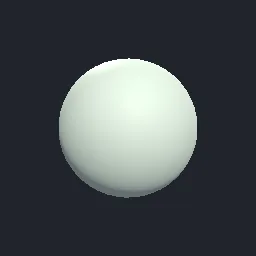
Build an evenly tessellated sphere by splitting a regular icosahedron into four triangles per face and projecting onto the sphere. Use it for physics bodies, planets and smooth balls.
What it takes and gives
- Entry points
- icosahedron, icosphere, main
- Parameters
- radius, subdivisions
- Complexity
- O(20 * 4^subdivisions)
- Axes
- +Y up, metres
Limits. No texture coordinates: an icosphere has no seam-free UV layout; add a spherical projection if needed. Triangles are close to equal but not identical in size (edge lengths vary by about 20 percent at three levels). The polygon volume is below the true sphere's.
Details
- Kind
- Mesh algorithm
- Engine
- Python 3.10 or later
- Files
- 10 files, 200.3 KB
- Licence
- MIT
- Declared effects
- reads files, runs commands, writes files
- Checked with
- Godot 4.7.2, gl_compatibility, OpenGL 3 driver, Mesa llvmpipe under Xvfb
- Checks
- generator runs system python, generator runs verifier python, gltf strict structure, interpreters agree, example matches generator, godot headless gltf load, godot compatibility render
- Techniques
- Regular icosahedron from three golden rectangles, Loop-free 1-to-4 midpoint subdivision, Radial projection to the sphere
- Tags
- primitive, sphere, icosphere, icosahedron, geodesic, subdivision
- Identity
library.supply.creative_originals.cd0a90a65f78add3bc5a98d1.f582515a00c85c5e- Version
f582515a00c85c5e98a51159179c237c6eafea3dc324cf28f96a6ce34c13ec2b
The version is the SHA-256 of the item your harness downloads; every file in it names its own checksum.
Something wrong with this item, its rights or its safety? Report it on the support page, or from your harness after a download.